
No products in the cart.
Introduction
Choosing an appropriate 110mm PECD configuration is essential for contractors in the telecom sector, designers of fiber-optic networks, infrastructure companies, and teams working on their equipment. Telecommunications systems set up underground require reliable systems for conducting and installing cables and expanding telecommunications networks. PECD is the name given to a Polyethylene Corrugated Duct with a diameter of 110mm. This kind of duct is also known as Corrugated Optical Duct. This duct can come with different arrangements of internal subducts. The three common types of subducts 3×42mm, 4×38mm, and 5×33mm. These arrangements all have the same overall size of the duct; however, the number of paths for cables provided by the systems and the size of subducts differ. Making a choice between a 110mm duct having 3×42mm subducts, 4×38mm subducts, or 5×33mm subducts is not just a matter of looking at the numbers of subducts. There are numerous requirements connected with the project that must be taken into account, including fiber dimensions and methods of installation.The choice of the correct PECD configuration for telecom projects in Saudi Arabia and other countries of the Gulf Cooperation Council would allow the contractors to organize their underground fiber routes better and plan
What Is a 110mm PECD?
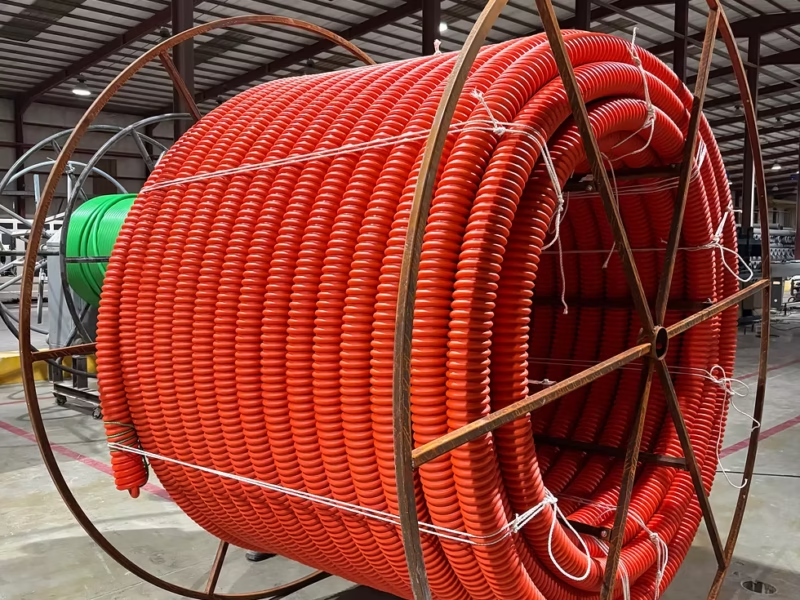
PECD refers to Polyethylene Corrugated Duct. In telecommunications, the term is used to describe an underground ducting solution that is used to house and secure communication cables and smaller subcolumns. This type of duct can also be referred to as a COD, i.e. Corrugated Optical Duct, when it comes to optical fiber networks. Commonly used 110mm PECD is composed of an enormous corrugated outer duct, into which several polyethylene subducts are fixed. The subducts offer internal compartments for the easy and orderly installation of fiber-optic cables. Outer duct forms the primary protective cavity, while subducts feature compartments for the installation of cables according to the project design. The approved solution can contain additional accessories, such as pulling ropes, marking colors, tracing wire, or others. PECDs can be used in many underground telecommunications infrastructures, including: - Fiber-to-the-Home (FTTH) networks - Fiber-to-the-Building (FTTB) installations - Fiber-to-the-x (FTTx) ventures - Telecom base and distribution networks - Underground fiber-optic routes - Road, railway, and industrial infrastructure projects - Utilities and other large-scale developments Choosing the right 110mm PECD design depends on the number and sizes of cable routes to be required as well as cable specifications and technical
Understanding the Three 110mm PECD Configurations
The primary distinction among the PECD configurations labelled 3×42mm, 4×38mm, and 5×33mm refers to the amount of internal subducts and each’s nominal external diameter.
1. 110mm PECD with 3×42mm SubductsA PECD 110mm that employs 3 subducts of 42mm each is made of three internal subducts with one external diameter of 42mm. This configuration provides three quite wide independent passages which are useful for projects that do not require multiple paths but rather bigger dimensions of the subducts depending upon the diameter of the cable, method of installation, and the approved engineering design.Sample project opportunities can be as follows:Use of optical-fiber distribution paths with three independent passages.Networks of various cables with big outside diameters.Use in infrastructure projects that require differentiated pathways.Projects that value dimensions of the subducts instead of the number of their paths.The diameter of 42mm is not the actually usable inside diameter since it refers to its external dimension.
2. 110mm PECD with 4×38mm Subducts
The 110mm PECD consists of the 4x38mm subducts and exhibits four internal subducts where every one of the subducts has a nominal diameter of 38mm.This format gives one additional pathway over the 3x42mm configuration although it has a smaller nominal subduct diameter.It may suit projects needing a compromise between pathway numbers and individual sizes of subducts.Possible applications comprise of:Fiber-optic distribution networks with four different routes.Telecommunication systems suitable for underground applications that require extra pathways separation.Projects planned for network expansion with many cable routes.Infrastructure corridors with four subducts that correspond to the approved cable routing.Similar to other configurations, when the useable diameter will be defined, one will have to check it against the selected cable as well as installation mode of cable.If required, the 4x38mm configuration should be chosen in other projects.
3. 110mm PECD with 5×33mm Subducts
A 110mm PECD with 5×33mm subducts contains five internal subducts, each with a nominal outside diameter of 33mm.Compared with the other two options, this arrangement provides the highest number of individual pathways. However, each subduct has a smaller nominal outside diameter.Potential applications include:Fiber-optic networks requiring five separately organized routes.FTTH and FTTx distribution infrastructure.Projects where multiple cable pathways are needed within one main duct.Network designs that benefit from route separation and planned future connections.The smaller nominal subduct size means cable compatibility must be assessed carefully. The internal diameter, cable diameter, bend radius and installation method will influence the suitability of this configuration.Main consideration: Select the 5×33mm configuration when five pathways are required and the proposed cables can be installed safely within the available internal dimensions.
How to Select the Right 110mm PECD Configuration
Selecting the right 110mm PECD configuration requires a systematic evaluation of the network design. The following considerations help engineers and procurement teams compare the three arrangements.
1. Identify the Number of Required Cable PathwaysStart by identifying how many separate cable routes the project needs.If the design requires three independent pathways, 3×42mm may be appropriate. If four separate pathways are required, 4×38mm may be a better match. If the project requires five separate pathways, 5×33mm may be worth evaluating.The number of subducts should correspond to the actual network layout rather than an assumption that more pathways are always better.Review the cable schedule, planned network topology, distribution points and any requirements for separating services before finalizing the configuration.
2. Check the Actual Internal DiameterOne of the most important steps in PECD selection is checking the usable internal diameter of each subduct.The nominal outside diameter is not the same as the internal opening. For example, a subduct with a nominal outside diameter of 33mm will have a smaller internal diameter because of its wall thickness.Before selecting a 110mm PECD configuration, obtain the approved dimensions for each proposed subduct. Compare these measurements with the outside diameter of the fiber cable or other cable intended for installation.Do not assume that every cable will fit simply because its diameter appears smaller than the nominal subduct size.
3. Consider Cable Installation by Pulling or BlowingThe intended cable installation method can affect which PECD configuration is suitable.Cable pulling depends on factors such as cable weight, route length, friction, bends, pulling tension and the manufacturer's installation limits. Fiber blowing depends on factors such as cable dimensions, duct internal conditions, route geometry, blowing equipment and the approved installation procedure.A smaller subduct is not automatically unsuitable for blowing, and a larger subduct does not automatically guarantee better installation performance. The entire cable-and-duct system must be evaluated.Where fiber blowing is planned, confirm the minimum internal dimensions and installation requirements with the cable and duct manufacturers.
4. Evaluate Current and Future Network RequirementsTelecom infrastructure is often designed to support future network extensions. Additional buildings, subscribers, industrial facilities and distribution points may require new cable routes over time.The 5×33mm arrangement provides five nominal pathways, while 4×38mm provides four and 3×42mm provides three. However, pathway count alone does not establish how many cables can be accommodated.Consider the number of planned routes, expected cable sizes, available internal space and the possibility of adding cables later. Spare capacity should be planned using the approved network design rather than relying only on the number of subducts.
5. Review Route Lengths and BendsUnderground duct routes may include long straight sections, curves, chambers, handholes and manholes.Route geometry can affect cable installation. Tight bends, excessive pulling tension, unsuitable transitions and poorly aligned joints may create installation difficulties or damage cables.Before selecting a 110mm PECD configuration, review the planned route and confirm that the cable can be installed within its specified minimum bend radius and pulling or blowing limits.Use compatible bends, connectors and closures where required by the project specification.
6. Confirm the Outer Duct and Subduct ConstructionThe main duct and internal subducts must meet the required material, dimensional and performance criteria.Review the following information:Main duct outside and inside dimensions.Subduct outside and inside dimensions.Wall thickness and dimensional tolerances.Polyethylene material grade.Corrugation profile and construction.Required stiffness and compressive performance.Color and identification requirements.Pull rope or trace-wire provisions, where specified.Jointing and accessory compatibility.Applicable inspection and test documentation.Not all products described as 110mm PECD have identical construction. Always compare the offered product against the relevant project specification.
7. Verify Compliance with Project RequirementsTelecom infrastructure projects may specify particular configurations, materials, dimensions, colors, accessories and acceptance tests.Some projects may require a particular subduct arrangement even when other options appear technically suitable. A contractor should not substitute 3×42mm, 4×38mm or 5×33mm without checking the approved drawings, bill of quantities and technical requirements.Confirm the required standards and approvals with the project consultant, client or responsible engineer before ordering.
8. Compare Total Project CostThe purchase price of a duct is only one part of the overall installation cost.A proper comparison should consider:Material and supply costs.Transportation and handling.Installation labor and equipment.Required joints, connectors and closures.Cable installation complexity.Testing and inspection requirements.Maintenance access.Potential future expansion.A configuration with more subducts may reduce the need for separate duct routes in some designs, but this outcome depends on the project layout and cable requirements. Evaluate total installed cost instead of choosing solely by price per meter.
Applications of 110mm PECD in Telecom Infrastructure
Fiber-To-The-Home Networks:
The infrastructure of the FTTH system is based on the optical fiber technology to connect the distribution network with individual customers. PECD systems help provide pathways underground for installing fibers, and the specific configuration of the network will determine the arrangement of ducts.The choice of the number of subducts (3,4 or 5) will depend on the required installation although the installation site, cable sizes, and overall cabling strategy
Fiber-To-The-Building Networks:
It is often necessary for commercial buildings, residential complexes and industrial facilities to set up several independent fiber optics cables. A proper PECD system should ensure proper separation of all installation paths and help set up the cabling.In developing a fiber installation plan, engineers should always take into account the cable sizes, the building’s current needs and future expansion plans.
Telecom Backbone Networks:
The backbone network is responsible for connecting major networks. Underground ducting is an effective means of organizing telecommunication and providing protection to fiber optic cables.A properly working PECD system should depend on cable quantity, design and cable installation methods.Industrial and Infrastructure DevelopmentIt is necessary to coordinate underground telecommunication systems when developing industrial areas and transport.
Industrial and Infrastructure Developments:
Industrial zones, transport corridors, new residential developments and large construction projects may require coordinated underground telecommunications infrastructure.A 110mm PECD system can form part of a larger duct network, provided its dimensions, installation conditions and performance meet the project requirements.
Final Recommendation: Which 110mm PECD Configuration Should You Choose?
The correct configuration of the 110mm PECD is dependent on the number of channels required, the inner dimension of the subduct, the cable installation process and the specifications of the project.
Use the 3 x 42mm configuration when there are three channels available and they are designed to accommodate cables with larger nominal diameters. Consider using the 4 x 38mm configuration when there are four channels required with smaller nominal sizes suitable for the cables.
Opt for the 5 x 33mm configuration when five channels are needed, and the inner size allows for cable installation. There is no single perfect configuration for every project. The best one is the one that is tailored to the network plan and is in accordance with the approved requirements. While purchasing, ensure that all major dimensions, materials, accessories and other necessary documentation is in place.
Frequently Asked Questions (FAQs)
1. What is a 110mm PECD?
A 110mm PECD is a nominal 110mm outside-diameter polyethylene corrugated duct used in underground infrastructure. It may contain multiple smaller subducts to provide separate pathways for telecom and fiber-optic cables.
2. What is the difference between 3×42mm, 4×38mm and 5×33mm PECD?
The configurations differ in subduct count and nominal outside diameter. The 3×42mm option has three 42mm subducts, the 4×38mm option has four 38mm subducts, and the 5×33mm option has five 33mm subducts.
3. Which 110mm PECD configuration has the most subducts?
The 5×33mm configuration has five subducts, providing the highest number of individual pathways among these three options. Actual cable capacity depends on the internal dimensions and cable requirements.
4. Is 3×42mm better than 5×33mm?
Neither is universally better. The 3×42mm arrangement provides fewer, larger nominal subducts, while 5×33mm provides more, smaller nominal subducts. The right option depends on the network design and cable dimensions.
5. What is a 4×38mm PECD used for?
A 4×38mm PECD provides four individual subduct pathways within a nominal 110mm outer duct. It can be considered for telecom projects requiring four separate routes, subject to project specifications and cable compatibility.
6. How do I check cable compatibility with PECD subducts?
Check the actual internal diameter, cable outside diameter, minimum bend radius and the installation method. Also verify pulling tension or blowing requirements against the cable manufacturer's instructions.
7. Can a 110mm PECD be used for FTTH projects?
Yes, PECD systems can be used in FTTH infrastructure when the selected product and configuration meet the network design, cable requirements and applicable project specifications.
8. What accessories are required for 110mm PECD installation?
Depending on the system, installation may require compatible duct couplers, subduct connectors, end caps, closures, chamber connections and pulling provisions. Confirm the required accessories in the approved project documentation.
9. What technical documents should I request before ordering?
Request the product datasheet, dimensional tolerances, material details, relevant test reports, compliance documentation and accessory compatibility information. Any client-specific approvals should also be confirmed.
10. How can I select the right 110mm PECD configuration for my project?
Identify the required pathway count, cable dimensions, installation method, route geometry, future expansion needs and project specifications. Compare the 3×42mm, 4×38mm and 5×33mm options against these requirements and obtain engineering approval before procurement.